Showing posts with label Torino. Show all posts

Tuesday, February 8, 2022

100 Days To EuroVision

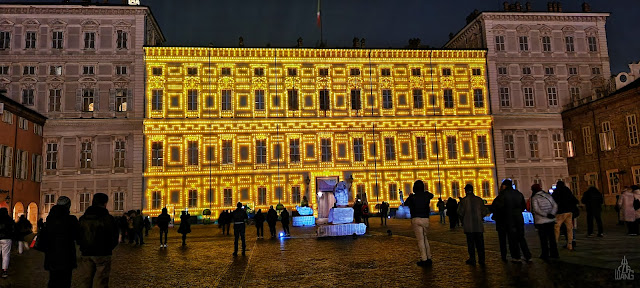
Turin is the hosting city for the Euro Vision song contest 2022, it will be held in May on the 10, 12 and 14.


To celebrate the event, a projection is cast onto the upper facade of La Mole, so everyone can see it and count down till the starting of the event.


Thursday, January 27, 2022

Above And Below

Piazzale Aldo Moro was an 'abandoned' area for a long time, then construction work began and for a long time it was working in progress.


The place is interesting because below the ground were hidden fragments of history, the remains of the foundations of the barracks of the cavalry of Carlo Emanuele I, and a large portion of one of the seventeenth century walls built to defend the city.

Now, the construction work has more or less completed and it is the university compound now, with restaurants and shops.

The most interesting aspect is the piece of ancient wall remains on the underground and the big opening above it which allow people to view the landmark, La Mole from below.


Wednesday, January 19, 2022

View From The Top

There are a few places in Torino that provide a view of the city center from a higher level, places like the top of La Mole and from the high level of the grattacielo San Paolo, although provide a magnificent panorama view of the city, but they come with a extra cost. Whereas, places like the Mont dei Cappucini and Superga are a bit far and needs to do some extra walking. From the above mentioned places the view is great and far, is marvellous, especially on a fine, clear day.

 View From Top Of La Mole


View From the 35th Floor of The Grattacielo Intesa Sanpaolo


View From Superga Hill

View From Mont Dei Cappucini

To get a more closer view but from a higher point in the center, there are some public places one can visit and go for the view.

One is up the tower of the Palazzo Madama, which has a lift to get you up to the top and it is situated right in the center of Piazza Castello.


 View From The Tower Of Palazzo Madama

The another one is the bell tower beside the Duomo which is accessible from the Museo Diocesano, it has no lift to bring you up but only 210 steps to climb till you get to the top, 210 small steps and it is worth the trouble just for the interesting view.


View From The Bell Tower - La Torre Campanaria


Saturday, January 8, 2022

2021 Christmas Lights

2021 had ended, as usual during the Christmas season, the city was decorated with lights on various streets, the highlight of 2021 season decoration was the video mapping inspired by the symbols of Christmas illuminting  the facade of the Palazzo Reale.


Palazzo Reale at Piazza Castello

Along the shopping street via Garibaldi

Along another shopping street via Lagrange

At piazza Carignano and via Academia delle Scienze which leads directly to the Egyptian museum


 Via San Francesco D'Assisi which leads to the Town Hall


Friday, August 30, 2019

Orto Botanico Of Torino

The Orto Botanico of theUniversity di Turin (2.6 hectares) is a botanical garden and arboretum operated by the Dipartimento di Biologia Vegetale of the University of Turin. It is located in the Parco del Valentino along the Po River, at Viale Pier Andrea Mattioli, Turin, Italy, and open weekends and holidays during the warmer months; an admission fee is charged.


The garden's origins can be traced as far back as 1560, when collections of live plants were established at the Studio di Mondovì, which moved to the university in 1566. Today's garden dates to 1713, when Victor Amadeus II of Sardinia established the Orto Regio. With establishment in 1729 of the university's chair in botany, held by G.B. Caccia, it legally became a part of the university.
Between 1730 and 1731 the garden was laid out in a geometric plan of flowerbeds within the Castello del Valentino's existing garden area (approximate 6800 m2), within which Caccia planted about 800 species. By 1762 some 1200 species were in cultivation. In 1796 Victor Amadeus III of Sardinia donated areas west and north of the castello, bringing the garden's area to somewhat larger than its current extent. By 1810 the garden contained about 6000 cultivated plants, with an arboretum organized on its northern section (the boschetto), and the constructions of greenhouses, orangery, and herbarium. Between 1831 and 1839 further construction added more greenhouses, and in 1848 a substantial orangery.


But the subsequent century saw considerable diminution of the garden. After 1876 various greenhouses were demolished to make way for laboratories, in 1892–1893 garden space was lost to further building, and in 1929, 1969, and 1977 additional greenhouses were eliminated. The garden was extensively damaged, with loss of collections, during World War I and World War II by neglect and bombings. However, the garden is now recovering. Prof. Bruno Peyronel introduced an alpine garden in 1962–1963, in 1969 a new greenhouse was built for tropical and subtropical species, in 1986 another greenhouse added for succulent plants, and in 2006 another for South African plants.
Today the garden proper cultivates around 2000 species, with an additional 300 species in the alpine garden, about 500 species in the arboretum, and a further 1000 species in greenhouses.


Although the garden is pretty small, but it is actually very interesting and provides a peaceful and enjoyable atmosphere for visitors who like to get away from crowd and chaos.


For people who criticize that the garden lack of pretty flowers and does not have a hugh species of plants, lets remember that there isn't much funding and it is more a vegetable garden than a flowers garden. Many plants and flowers are seasonal, so don't expect to see them blossom all year round.

Tuesday, August 13, 2019

Mercato Centrale

Mercato Centrale is located in Porta Palazzo, where the big open air market is.


It was just a shopping complex with mainly shops selling clothings and other mainly uninteresting goods. It is now renovated and upgraded to quite a chic eating place where some really nice and impressive foods are served at the ground floor, the first floor remains mainly shops and with a spacious 'room' to serve for events, such as private party, exhibition etc. 
The most interesting aspect of this floor is actually the terrace which can oversee the open air market at a higher level, which makes it perfect spot to photograph the market.


Whereas, at the basement, there is the antique ice house, the ghiacciaie where once ice was kept and distributed. 


The Mercato Centrale opens still past midnight everyday, being at the not really safest spot of the town, it really needs to be a lot more convincing to get visitors coming after the evening, plus the foods although are of better quality than most eating places in town, but so are the prices higher....

Please visit https://www.mercatocentrale.it/torino/ to know more about the place.

Sunday, May 6, 2018

Fontana Angelica

The fountain Angelica is situated in piazza Solferino, one of the beautiful piazza in Turin.


Inaugurated in 1929, it consists of four impressive groups of statues that represent the four seasons. It was commissioned by the mayor Riccardo Cattaneo on a project by the sculptor Giovanni Riva,  thanks to the financing by testamentary legacy of the minister Paolo Bajnotti (1842-1919), and it took the name of his mother Angelica Cugiani Bajnotti. Initially it was decided to place the fountain in front of the Cathedral, in Piazza San Giovanni, but then Piazza Solferino was chosen due to opposition of the Church. The figures of the four seasons would have in fact multiple symbolic Masonic and Mythological values:
Spring: female statue on the lower eastern side outside, it represents the sacred love, the virtue, with a nest of birds in her lap and a child who throws a flock of swallows in the air.Summer: a female statue on the lower western side outside, it represents the profane love, the vice, and holds in the lap of the ears, with a child holding a garland of fruit.Autumn: a male statue to the east but looking westward, represents Boaz, one of the supporters of the Pillars of Hercules.Winter: central statue to the west but looking towards the east, represents Jaquim, the other supporter of the Pillars of Hercules.

Thursday, April 12, 2018

Reflection After The Rain

Has been raining for a few days, ponds of water left on the ground which help to reflect the gorgeous setting of Torino.


One of the favourite location to take a reflction shot is definitely in piazza Castello, in front of the fountain right in center with the Royal Palace.

Thursday, August 10, 2017

The Squares 1- Le Piazze 1 - Piazza Castello And Piazza San Carlo

There are many piazza in Turin, just like all the other Italy cities, the main and bigger piazza in the center of Turin are Piazza Castello, Piazza Vittorio, Piazza San Carlo, Piazza Carignano, Piazza Carlo Alberto, Piazza Statuto, Piazza Solferino....


Just some 10, 20 years ago, some of the piazzas were quite different from what they are now......
Piazza Castello was full of parked cars, and the piazza was very, very much less 'decorated' as today.
Piazza Castello is the second largest piazza in Turin, it was designed by Ascanio Vitozzi back in 1584.


Remember when I first arrived in Turin, the piazza was full of parked cars, the buildings on the three sides were astonishing beautiful, but the same couldn't be said for the grayish piazza.
Now, various modification have been done, the car park was removed, the stone pavement was restored and cleaned, fountains were added and later with colors lights installed. Now the piazza is lively and vidid, often animated by street artists performing in the piazza, concerts are also often held in the piazza, in summer, the fountains are basically the playground of children to have fun with the water.


In the piazza, are located some major attractions of Turin. Right in the center of the piazza there is the Royal Palace, the Palazzo Madama, the church San Lorenzo which once kept the holy shroud when It was first arrived in Turin and now still keepin a copy of the shroud, the Palazzo della Prefettura-Armeria Reale and the Teatro Regio, the most important theatre in Turin on one end. In addition, there are 3 historic and spectacular monuments in the piazza : the Monument to the Knight of Italy, the work of Piero Canonica of 1923, the Statue of the army of Sardo Bishop, by Vincenzo Vela in 1859 and the monument dedicated to Emanuele Filiberto Duke of Aosta.


Three sides of the piazza link to the 3 major shopping streets of Turin :
In front of the palazzo Madama is via Garibaldi, one of the longest pedestrian streets in Europe with many shops and restaurants. In the direstion towards the train station Porta Nuova is via Roma, a high end shopping street with many luxury products shops and is partially closed off to traffic. In front of the monument dedicated to Emanuele Filiberto Duke of Aosta is via Po which leads to the river Po, an interesting street with lots of shops, bars, restaurants and a row of used books stalls under the arcade.


Overall, the piazza is a perfect point to start exploring Turin, it has an historical sense and a vibrant atmosphere

From piazza Castello walk along via Roma, one reaches piazza San Carlo.


Piazza San Carlo is one of the most important squares of the historic center of Turin. Often dubbed by Turin the "living room" of the city, it is inserted into the axis of Via Roma road, which connects Piazza Castello and Piazza Carlo Felice.The most beautiful of Turin, former parade and the market ground , it maintains the seventeenth aspect of harmonious uniformity conferred by the Royal Carlo di Castellamonte (1642-1650).


In the center stands the equestrian statue of Emanuele Filiberto, represented by Carlo Marocchetti (1838) in the act of sheathe his sword after the battle of St. Quentin in 1557, one of the most important statues of the early nineteenth century (nicknamed El Caval d'brons) .The short side of the south-west square is bordered by the almost twin façades of the churches of Santa Cristina and San Carlo.


Noble palaces that overlook the Piazza San Carlo, among which should be noted, at n. 183, the Palazzo Solaro del Borgo. A three-storey palace, with an elegant facade and porticoed to a sixteenth-century Castellamonte design for the Marquis de Senantes, then repainted by Benedetto Alfieri in 1753 for the Carnation Isniars, then sold in 1770 to the Asinari family of Bernezzo, who refurished it and in turn, in 1782, sold to the Solaro del Borgo. Today it is used as a hotel and as the seat of the Turin Philharmonic Society.


Worthy of a visit are the traditional cafés San Carlo, which opened in 1842, the Turin Coffee and pastries Stratta brothers, with the original furnishings of 1836.Recently completed, in 2004 work began on the redevelopment of the square, with its full pedestrianization through the progressive elimination of vehicular traffic and no parking to cars and the creation of a distributed underground parking on one level that will host 380 parking spaces.

Worth to pay attention also to the pavement of the piazza which often is the subject of many photographers.
Years ago, the piazza was less attractive, as traffic was allowed to pass through and cars would just went round and round the piazza like a parade.